

Sewing takes patience, and I’m not the most patient person when it comes to costume making. I always look for ways to cut corners and still achieve the same results, and I love when performing 1 task achieves more than 1 result.
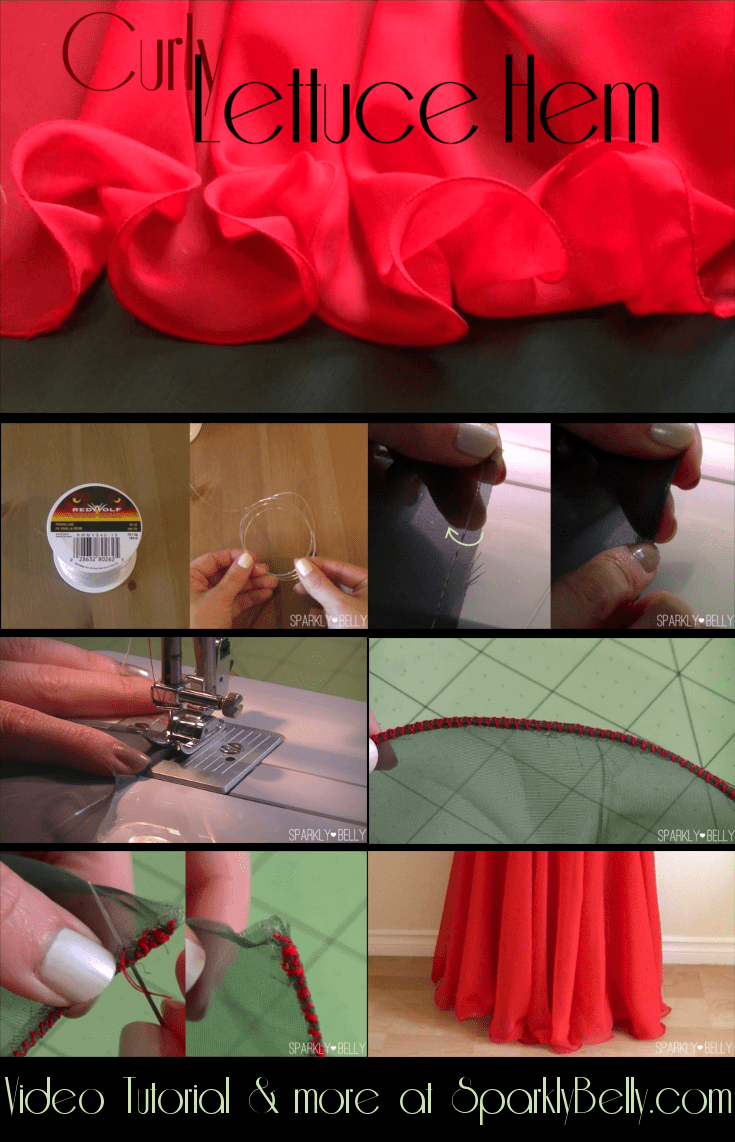
This lettuce hem technique is one that hems your skirt AND creates the curly, ruffly effect at the same time!
So in this video, you will see how to create this curly hem, sometimes called lettuce hem, with fishing line and finish up the hemming of your skirt at the same time 🙂 So let’s get started.
Click here to sign up for the Sparkly Belly newsletter!
To make the curly fishing line hem, you need:
Fishing line – You need clear colour fishing line like this. I bought mine at Canadian Tire, but in the US, I believe even Walmart carries it. Don’t pick those green, soft ones that might be displayed in the same area. This one cost me about $4, and I think it’s going to last me for 20 circle skirts! I know nothing about fishing, but I saw at the store that this type of fishing line comes in different weights. This one is 40lbs, and for creating curly hem, get fishing line that is at least 30-40lbs. And they come in big spools.

A skirt to hem – To accommodate the curls, the hem of the skirt needs to be able to stretch a little. Circle skirts would always work, because the fabric is cut on the bias. If you want to add curls to the hem of a straight skirt, for example, try first on a piece of scrap fabric and see if the fabric has enough stretch for curls to work.
Matching colour thread
Sewing machine that can do a zigzag stitch
How to Make Curly Lettuce Hem / Fishing Line Hem
First, decide if you like the size of the curls that the fishing line comes in. I like the size of the curls that my fishing line has, but I decided to experiment anyway so I can show you.
So if you want smaller curls, find a cylinder shape object. Here, I experimented with a paper towel roll and a highlighter. Just tape the end of the fishing line to the cylinder, and wrap the fishing line around it nice and tight, as much as you need. Tape the other end. Then, I used a blow dryer to heat up the fishing line and let it cool – just like curling your hair!

Once it’s cool to the touch, it’s ready.
Here are the differences. For a belly dance circle skirt, I think these large curls work just fine, so that’s what I use, and I can skip this step. But if you are making more delicate curls, you can go ahead and make small curls before sewing 🙂


So, to sew this fishing line, this is how you set up your sewing machine. Set your sewing machine to do a zigzag stitch, and for my machine, I’m using the largest width at 5, and the stitch length at 1.5. You can use a regular presser foot. I’m using red thread in this example against dark green fabric so you can see the stitches, but for your skirt, use a matching colour thread.
Now, I find it helpful to place the spool of your fishing line in a container or box like this right underneath your sewing table. Gravity helps keep the fishing line straight when you sew. (Otherwise, you will have a curly mess all over your sewing machine!)

Take the end of your skirt, place your fishing line a few mm or 1/8 in or so from the edge, leaving at least 20 cm or so of extra fishing line here. Fold over the edge to cover the fishing line, and place it under the presser foot. Lower the needle making sure it holds the folded fabric, then lower the presser foot. Backstitch a little, and start sewing. The needle will go either side of the fishing line, creating a tight casing around the fishing line and securing the folded fabric in place. Fold the edge over with your right hand to help this process.


Make sure the fishing line stays right in the middle by guiding the fishing line from both the front of the needle and back of the needle. The tendency of curly fishing line is to go sideways, so be sure to gently guide it.

You may feel like you are stretching the fabric, and it’s okay. In fact, as you go, some parts are stretchier, and you need to stretch and fold over the fabric more often to keep the zigzag stitch going.
If you find it difficult to just fold over a few mm of fabric, you can go ahead and fold over more, then after you finish stitching, you can go back in with small scissors and trim the excess fabric. But I thought I probably won’t have that much patience, so I practiced sewing with a small seam allowance. 🙂

How to trim the ends of the fishing line
So before you trim off the extra fishing line, make sure your skirt hem has enough fishing line all the way. Then, make a knot very close to the edge of the skirt, and snip the end leaving about 2.5cm or 1in extra fishing line.
Fold it over, and take a threaded needle, and we’ll sew over the extra fishing line to secure it to the hem. I start from somewhere close to the knot, go through the small gap of the knot. Then tighten the knot, then take your needle again and go over the hem. Come back out, go over the fishing line and the hem, then back out a millimeter away. Keep going until the extra fishing line is completely covered.


By going through the knot, you can make sure the fishing line doesn’t slip out of the stitches. 😉
You can finish the ends like this, but for added security, I put some E6000 on a piece of scrap paper, and dab the knot and this hand stitched section, and leave it to dry. Once it’s dry, it’s finished.

So here is a skirt I’m working on. As you can see, the fishing line gives a lot more volume and drama to the skirt, and it doesn’t take that much longer to do than regular hemming!

Hope you liked this technique, and if you make your own, please share a photo on Sparkly Belly’s Facebook page. And sign up for the Sparkly Belly newsletter from the below link to get tips like this in your inbox and free access to special patterns and resources on the subscriber only page. 😉
Click here to sign up and get access to the subscriber only page 🙂
Thanks for reading, and keep sparkling!
P.S. Happy pinning 🙂
Want to make more costuming bits yourself?


Love this technique. I’m wondering if it would work on a light weight satin. I’ve a skirt that could do with a reinvent. Thanks
Thanks, Helen! You can use fishing line on any skirt that is either cut on the bias or made from stretch fabric. It’s because the skirt hem needs to be able to stretch in order to accommodate the curls. So if your satin skirt is a long circle skirt made from circular panels, which should be cut on the bias, then it should work 🙂
Thanks Ill let you know how I get on. 🙂
THank you for such a great tutorial! I’m going to yse this technique to give a little makeover to an old tea length parfy dress I found at a thrift store!
My pleasure, Ellie! What a wonderful makeover that would be! 😀
Great tutorial!!!! Thanks a ton!
My pleasure, Diana! 🙂
Would this work with a 6lb fishing line?
Hi Alyssa! I’ve never tried light weight one like that myself… If you’ve got some already, you may want to test with a small piece of fabric to see if it holds up curls 🙂
I tried this a few times but not all the hem goes curly…I am sure i have followed all the instructions I used it on a long chiffon dress,,,parts are curly and parts are straight!! I NEED to fic this for the weekend!¬ can anyone help?? Thankyou!
Hi Ann! Would it be possible to put a link to the photo of the hem here? Or, if you’re on FB, post a photo and your question in Sparkly Belly’s FB group (http://www.facebook.com/groups/sparklybelly) and I’m sure someone will help, since everyone there is super helpful! 🙂
muchas gracias por disipar mis dudas.
My pleasure! 🙂
[…] And they come in big spools, and a spool like this is more than enough to make ruffles or do the fishing line hems for a bunch of […]
[…] And now as you can see, the curls are more defined and three-dimensional! You can see a more detailed instruction on how to do this in my lettuce hem tutorial. […]